

The double hattrick is one of cricket’s more misunderstood achievements — many fans imagine a “doubled” hattrick to be six wickets in six balls, but the logic comes through two overlapping hattricks, taking four consecutive wickets counts as a double-hattrick: balls 1-2-3 and balls 2-3-4. This is the most generally recognised definition in cricketing culture, despite not being a formal definition by the ICC itself. That brings us to the very important question: how many wickets constitute a double hat-trick? The answer is four — and it requires not merely great skill, but also the right timing, related circumstances, and a remarkable amount of luck happening simultaneously.
What is a Hat-trick?
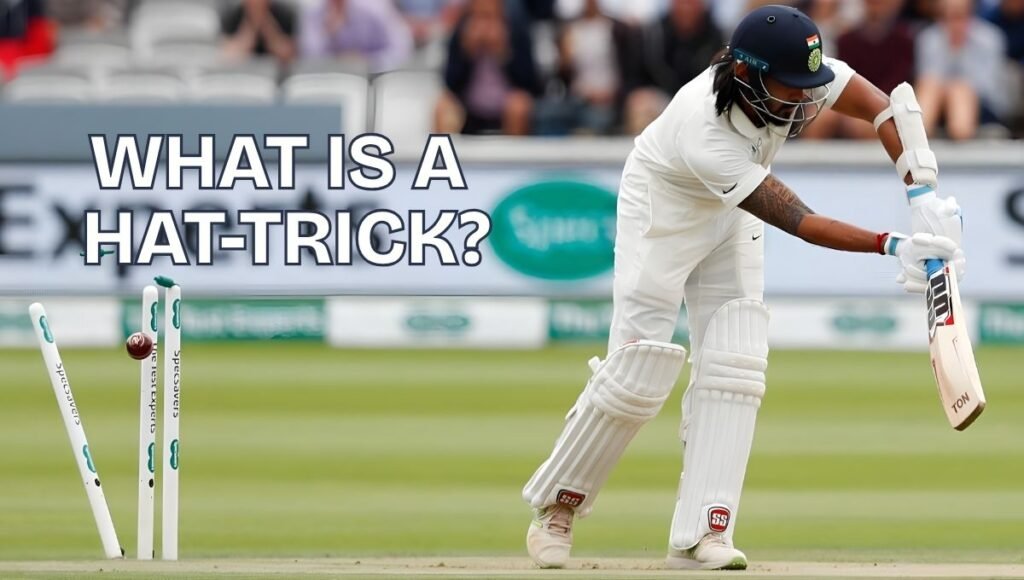
To comprehend double hat-trick, we must first be informed with the definition of hat-trick in cricket.
Hat-trick means the bowler has taken three wickets off of three legal deliveries. They’re not required to be in the same over – indeed they could cover two innings in a Test match – but the three wickets must come from the bowler’s next three legal deliveries that day.
Only wickets that are awarded directly to the bowler count. This includes bowled, caught, Leg Before Wicket (LBW), stumped and hit wicket dismissals. This will also exclude run-outs, since they are not ascribed to the bowler.
Hat-tricks are rare in themselves. Only 49 hat-tricks have been taken in the history of Test cricket. 52 hat-tricks have been taken in ODI cricket. However, a normal hat-trick is relatively common when compared to a double hat-trick!
How many wickets constitute a double hat-trick?
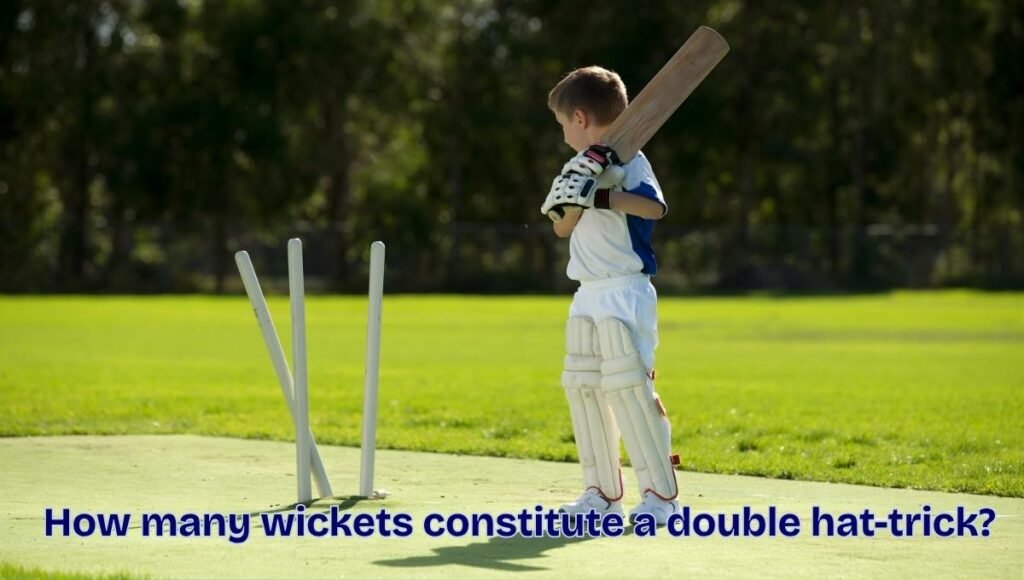
If a bowler takes four wickets in four consecutive legal deliveries, it is called a double hat-trick.
For the ways to count:
- The four wickets must all be from continued legal deliveries.
- Wickets have to be awarded in the same hands.
- Apart from a few sequences of wides and no-balls.
- These deliveries can be covered across the course of two overs.
- So a bowler might take a wicket from the last ball of one over, and then take three more wickets with their first three balls of their next over.
Myths About the Double Hat-trick
Myth 1: Double hat-trick = six wickets in six balls (two hat-tricks put together!)
Fact: No. Double hat-trick means four wickets in the first four balls, i.e., not two successive hat-tricks in modern-day cricket.
Myth 2: Run-outs can figure in double hat-tricks (Fabric of Myth 2)
Fact: Wrong. Only wicket-maiden runs are not credited to the bowler, so they cannot be part of a hat-trick or double hat trick sequence.
Myth 3 : Four wickets need to come within the same over.
Fact: Not necessarily. These four wicket knockouts can span across two overs or even two innings (Test cricket) but as long as they are the bowler’s next four legal deliveries.
Myth 4: A double hat-trick is recognized by the ICC
Fact: A “double hat-trick” is not a recognized term in the ICC’s official lexicon. Although it is regarded as an informal term, commentators, scorers and fans across the globe accept this. That’s the definition, but that’s a bit of a misnomer.
Key Difference: Hat Trick vs Double Hat-Trick
| Features | Hat- trick | Double Hat- trick |
| Wickets required | 3 | 4 |
| deliveries(balls) | 3 Legal balls | 4 Legal balls |
| difficulty | Extremely difficult | Very Rarer |
| frequency | Rare | Extremely rare |
| Can span 2 overs? | Yes | Yes |
| Run out counts? | No | No |
Double Hat-trick Rules in Cricket
These are the precise rules that qualify a bowler for a double hat-trick:
- You need to take 4 wickets with 4 consecutive deliveries.
- The bowler receives a (bowled, caught, LBW, stumped, hit wicket) for each wicket.
- And, in case the sequence involves a run-out — they do not count.
- It can be for two overs — last two balls of one over and first two balls of the next.
- In Test cricket, the sequence can last up to two innings in one single match.
- That ends a chain of 2 deliveries as a wide comes in without a wicket. But a stumping off a wide is still the bowler’s wicket and continues the sequence.
- It is also broken by a no-ball that does not dismiss a batsman.
First Double Hat-trick in Cricket
Lasith Malinga of Sri Lanka in 2007 during ICC Cricket World Cup against South Africa in Guyana, was the first double hat-trick (including Four Wickets in Four Balls) ever in International cricket. That is still one of the most sensational pieces of bowling in cricket history.
The context around it further makes it unbelievable. South Africa was in a strong position at 206/5, needing only 4 to win with 5 wickets left. Malinga claimed the wickets of Shaun Pollock, Andrew Hall, Jacques Kallis and Makhaya Ntini with four balls in a row — South Africa slipping from 206/5 to 206/9 in no time. South Africa might have won the match at a canter, but Malinga’s spell will forever be remembered in cricket history.
Double Hat-Trick in T20 Cricket

From the seven instances of a double hat-trick coming in international cricket, it has been T20 which has led to five of those. It’s hardly surprising; T20 batsmen are often riskier in their approach, the death overs come up far quicker and pressure situations seem to arrive sooner too than in the shortest format.
| Bowler | Team | Opponent | Year | Context |
| Rashid Khan | Afghanistan | Ireland | 2019 | First T20I double hat-trick. Finished with 5/27 |
| Lasith Malinga | Sri Lanka | New Zealand | 2019 | Malinga’s second career double hat-trick. A record. |
| Curtis Campher | Ireland | Netherlands | 2021 | First double hat-trick in a T20 World Cup. Finished 4/26. |
| Jason Holder | West Indies | England | 2022 | Taken in the final over. West Indies won by 4 runs. |
| Waseem Yaqoob | Lesotho | Mali | 2024 | Africa T20I Qualifier. Took 6/18 in 4 overs. |
| Hernan Fennell | Argentina | Cayman Islands | 2024 | Americas T20I Qualifier. Fennell also took a fifer. |
Double Hat-trick in Test Cricket
No player has ever taken a double hat-trick in Test cricket as of June 2026. Partly due to the fact that Test cricket is expected to be more bowler-friendly match conditions than any of the other forms, it equally seems true that batsmen in longer format are more meticulous and pragmatic in nature. Test cricket rewards patience, and the defensive focus of Test batsmen makes it much harder to force four consecutive errors.
But by the letter of the laws it is perfectly allowed — and indeed, a double hat-trick in Test cricket across two innings in the same match is theoretically possible as long as those are the next four legal deliveries credited to that bowler.
Double Hat-trick in ODI Cricket
Only a single double hat-trick has ever been taken in ODI cricket — Lasith Malinga’s unforgettable opening spell against South Africa in the 2007 World Cup (chronicled above). No bowler has repeated the trick at the 50-over level since Malinga did it, despite thousands of ODI matches since.
| Bowler | Match | Year | Wickets |
| Lasith Malinga | Sri Lanka vs South Africa (world cup) | 2007 | Pollock, hall, lengeveldt, Ntini |
Conclusion
A double hat-trick is one of the most remarkable achievements in cricket. It does not seem as it looks because many fans see it as six wickets but in reality it is about taking 4 wickets in 4 consecutive deliveries, creating two hat tricks which overlap each other.
It is one of the rarest achievements in the game, with just a few handful examples including international examples and none at Test level. Whatever the occasion, it is absolute bowling supremacy and is instantly recorded as a part of cricket history.
FAQs
A1. A double hat-trick is four in a row delivered by the same bowler (4 wickets on 4 legal balls).
A2. Yes. Four wickets in four straight lawful balls — is the universally accepted definition.
A3. Yes. The wickets may happen at the conclusion of one over and the start of the following bowler’s next over.
A4. Yes, Lasith Malinga (twice), Rashid Khan, Curtis Campher and Jason Holder are in the list.
A5. A double hat-trick and a perfect over are both significantly rarer than the usual hat-trick.
Also Read: