
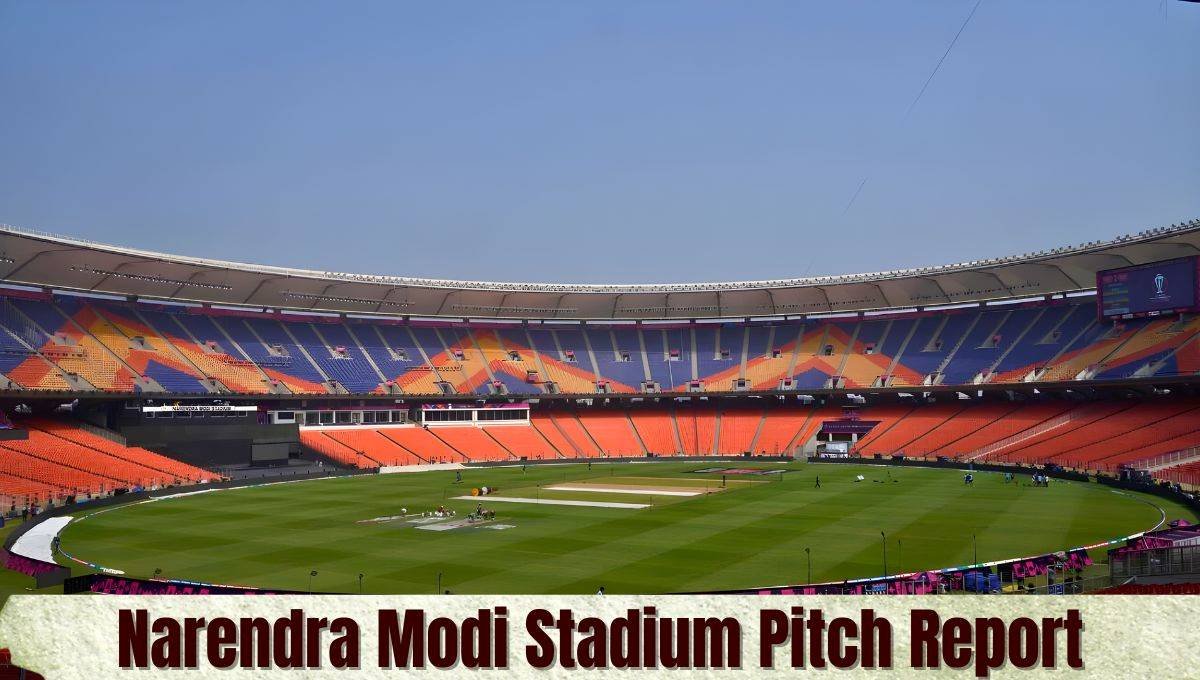
The Narendra Modi Stadium in Ahmedabad, Gujarat is the largest cricket stadium in the world. With a seating capacity of over 132,000 spectators, it stands as a monument to India’s cricketing ambitions and its deep love for the sport. Located in Motera, the stadium is a venue that commands respect from players and fans alike. Whether it is a high-stakes Test match, a pulsating ODI, or a thrilling IPL encounter, the Narendra Modi Stadium delivers an atmosphere unlike any other in world cricket. Understanding its pitch and conditions is essential for anyone following the game at this iconic venue. The article dwells on the recent Narendra Modi Stadium Pitch Report, weather, recent T20 scoring tendencies, toss angle, weather and the insight of the practical match-day.
Narendra Modi Stadium Overview
| Attribute | Details |
| Full name | Narendra Modi Stadium |
| Location | Motera, Ahmedabad, Gujarat, India |
| Capacity | 132,000+ (largest in the world) |
| Owner | Gujarat Cricket Association (GCA) |
| Established | 1983 |
| Rebuilt | 2020 |
| Architect | Populous (Australia) |
| IPL home team | Gujarat Titans |
| Pitch type | Red soil — flat, true bounce |
| Floodlights | Yes — 360° LED system |
| Former name | Sardar Patel Stadium (Motera) |
| Corporate boxes | 76 |
| Avg. ODI 1st innings score | 270–300 runs |
| Avg. T20 / IPL score | 160–175 runs |
| Notable match hosted | 2023 ODI World Cup Final |
Narendra Modi Stadium History and Development

The original Motera Stadium was established in 1983 and quickly became one of India’s premier cricket venues. Managed by the Gujarat Cricket Association (GCA), it hosted numerous memorable matches over the decades. However, by the 2010s, the ageing infrastructure prompted a bold decision — to tear down the old stadium entirely and build a brand new world-class facility from scratch.
Construction of the new stadium began in 2017 and was completed in early 2020. The project was developed by the renowned architecture firm Populous, the same firm responsible for iconic venues like the Melbourne Cricket Ground and Lord’s. The authorities formally inaugurated the stadium in February 2020 during the “Namaste Trump” event to welcome then-US President Donald Trump. In February 2021, officials officially renamed the venue the Narendra Modi Stadium to honor India’s Prime Minister, a Gujarat native.
The venue features five Olympic-sized swimming pools, a clubhouse, indoor cricket academies, 76 corporate boxes, and a 360-degree LED lighting system. The stadium defines the modern era of cricket.
Narendra Modi Stadium Weather Report
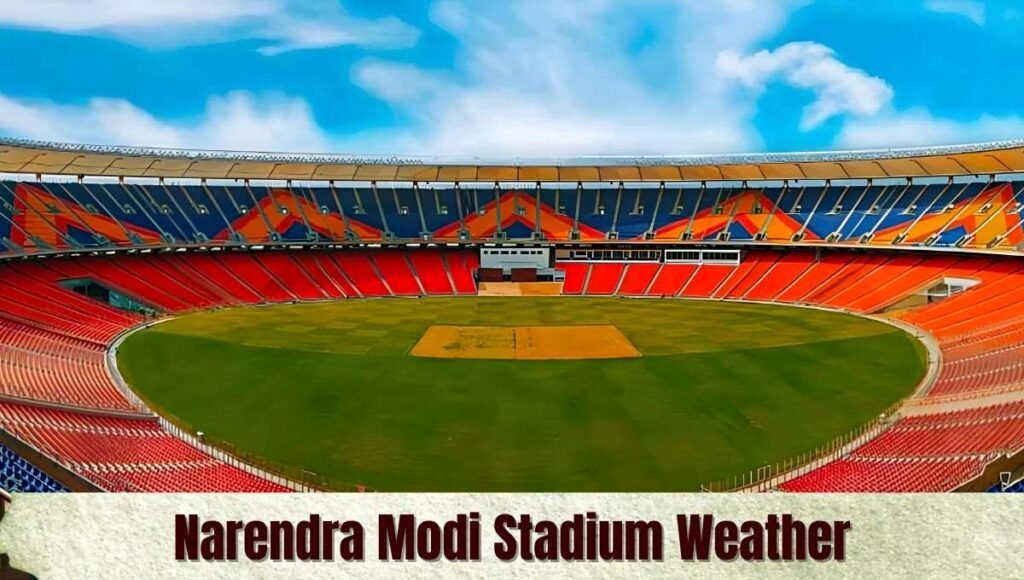
Ahmedabad’s climate plays a significant role in how matches unfold at the Narendra Modi Stadium. The city experiences a semi-arid climate with three distinct seasons — summer, monsoon, and winter.
- Summer (March–June): Temperatures can soar beyond 40°C, making daytime cricket extremely demanding. Matches during this period are often played under lights to provide some relief from the heat.
- Monsoon (July–September): Heavy rainfall can cause interruptions and even lead to abandoned matches. Humidity levels are high, which can assist swing bowling early in the innings.
- Winter (October–February): This is the ideal cricket season in Ahmedabad. Temperatures range between 15°C and 28°C, conditions are dry, and there is rarely any cloud cover or rain interruption. Most international matches are scheduled during this period.
For IPL matches (typically April–May), teams must contend with warm evenings. The dew factor under floodlights can significantly impact the toss decision, often making chasing a preferred option.
Narendra Modi Stadium Pitch Report
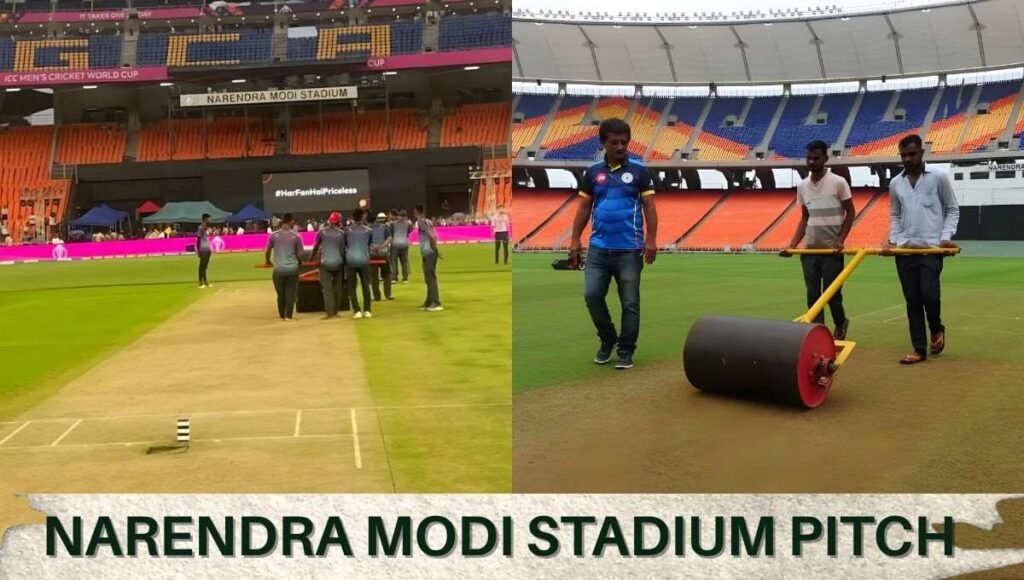
The pitches at the Narendra Modi Stadium have evolved considerably since the new ground was constructed. The surface is prepared using red soil, which is known to produce true and consistent bounce.
Nature of the Pitch: The pitches here tend to be flat and batting-friendly in the early stages of a match. Batters can play their strokes freely, and the large boundaries (especially square of the wicket) keep scoring rates in check despite good conditions. Fast bowlers can extract some movement early on, particularly when the ball is new, but the pitch generally flattens out quickly.
As the match progresses — particularly in Test cricket — the surface begins to deteriorate. Cracks start to appear, the ball grips and turns, and spinners come into their own. Off-spinners and leg-spinners can be devastatingly effective in the second innings of a Test match on this surface.
Key Characteristics:
- Average first innings score (T20I): Approximately 155–170 runs.
- Toss: Winning the toss and batting first is generally preferred in Tests and ODIs. In T20Is and IPL games, chasing is often favoured due to dew.
- Pace bowling: Effective with the new ball; swing is possible in early mornings or evening sessions.
- Spin bowling: Increasingly effective as the game progresses, especially in Tests from Day 3 onwards.
- Average first innings score (ODI): Approximately 270–300 runs.
Narendra Modi Stadium Records
International Match Records
The Narendra Modi Stadium has hosted some of the most significant international fixtures in recent years. Here are the highlights:
- The stadium hosted the iconic India vs England Test in February 2021, which India won by a massive 10 wickets. The pitch drew controversy as it offered significant turn from Day 2, with spinners — especially Axar Patel and Ravichandran Ashwin — running through England’s batting line-up.
- The 2023 ODI World Cup Final between India and Australia was held here in November 2023, in front of a record-breaking crowd. Australia won the match chasing 241, with Travis Head playing a match-winning knock.
- India have a strong home record at this venue, winning the majority of their Tests and ODIs played here.
- The stadium also hosted the India vs Pakistan clash during the 2023 World Cup, which attracted a global audience of hundreds of millions.
In T20 Internationals, high scores have been registered, with batters exploiting the true bounce and fast outfield. The stadium’s dimensions demand smart cricket — big hitting needs precision placement.
IPL Match Records
The Narendra Modi Stadium serves as the home ground of Gujarat Titans, who joined the IPL in 2022. It has also been used as a neutral venue for high-profile IPL matches and playoff games.
The average score in IPL matches at this venue is around 165–175 runs, with teams batting first winning approximately 45% of the time.
- Gujarat Titans had a phenomenal debut season in 2022, winning the IPL title largely thanks to their home advantage. The crowd support and pitch knowledge proved decisive.
- The stadium hosted the IPL 2022 and IPL 2023 finals, with massive crowds creating electric atmospheres.
- High scores are achievable here during the powerplay due to flat conditions, though spinners are effective in the middle overs as the pitch slows down.
- Hardik Pandya, Shubman Gill, and other Gujarat Titans players have consistently performed well, knowing the ground conditions intimately.
Recent Matches at Narendra Modi Stadium
| Date | Tournament | Teams | Score | Winner | Result |
| 20 Apr 2026 | IPL 2026 | Gujarat Titans vs Mumbai Indians | MI 199/5, GT 100 | Mumbai Indians | MI won by 99 runs |
| 17 Apr 2026 | IPL 2026 | Gujarat Titans vs Kolkata Knight Riders | KKR 180, GT 181/5 | Gujarat Titans | GT won by 5 wickets |
| 4 Apr 2026 | IPL 2026 | Gujarat Titans vs Rajasthan Royals | RR 210/6, GT 204/8 | Rajasthan Royals | RR won by 6 runs |
| 8 Mar 2026 | ICC Men’s T20 World Cup Final | India vs New Zealand | India 255/5, NZ 159 | India | India won by 96 runs |
| 22 Feb 2026 | ICC Men’s T20 World Cup, Super 8 | India vs South Africa | South Africa 187/7, India 111 | South Africa | South Africa won by 76 runs |
| 18 Feb 2026 | ICC Men’s T20 World Cup, Group Stage | India vs Netherlands | India 193/6, Netherlands 176/7 | India | India won by 17 runs |
| 14 Feb 2026 | ICC Men’s T20 World Cup, Group Stage | New Zealand vs South Africa | NZ 175/7, SA 178/3 | South Africa | South Africa won by 7 wickets |
Conclusion
The Narendra Modi Stadium is more than just the world’s largest cricket ground — it is a venue with real cricketing character. Its pitches reward skilled batters early and wily spinners later, making it a complete test of a team’s all-round abilities. The weather conditions, especially during winter internationals, create near-perfect cricket conditions. Whether you are a player, analyst, or fan, understanding the Narendra Modi Stadium pitch report gives you a decisive edge in predicting match outcomes and appreciating the nuances of every game played here.
FAQs
A1. The stadium has a seating capacity of over 132,000, making it the largest cricket stadium in the world.
A2. The pitch is batting-friendly in the early stages but increasingly assists spin bowlers as the match progresses, particularly in Test cricket.
A3. Gujarat Titans is the home IPL team based at the Narendra Modi Stadium in Ahmedabad.
A4. Yes, dew is a significant factor during evening T20 matches, which often makes chasing the preferred option after winning the toss.
A5. The winter months of October to February offer the best weather conditions for cricket, with comfortable temperatures and minimal chance of rain.
A6. The stadium was renamed from Sardar Patel Stadium (Motera Stadium) to Narendra Modi Stadium in February 2021.
Also Read: Ekana Cricket Stadium B Ground: Weather, Pitch Report, Stats, IPL Match, Records and More